
Developing Karate
Developing Karate, The Hidden Arts Involved
At first glance, Karate appears simple - strikes, kicks, blocks, and forms practiced with precision and discipline. But beneath that clean, powerful surface lies something far richer. Karate, as it developed and spread from Okinawa to Japan and beyond, quietly absorbed and reflected elements from other martial traditions. Among the most influential are Judo, Aikido, and Kobudo - three arts that, when understood together, reveal the deeper, often “hidden” layers of Karate.
This is the story of how those arts intertwine, shaping Karate into far more than just a striking system.
A Shared Beginning
Karate did not emerge in isolation. It’s roots trace back to Okinawa, where local fighting methods blended with Chinese martial arts. At the same time, mainland Japan was developing its own systems, particularly Jujutsu, a battlefield art focused on grappling, joint locks, and efficient control of an opponent.
From this common ancestry, different branches grew:
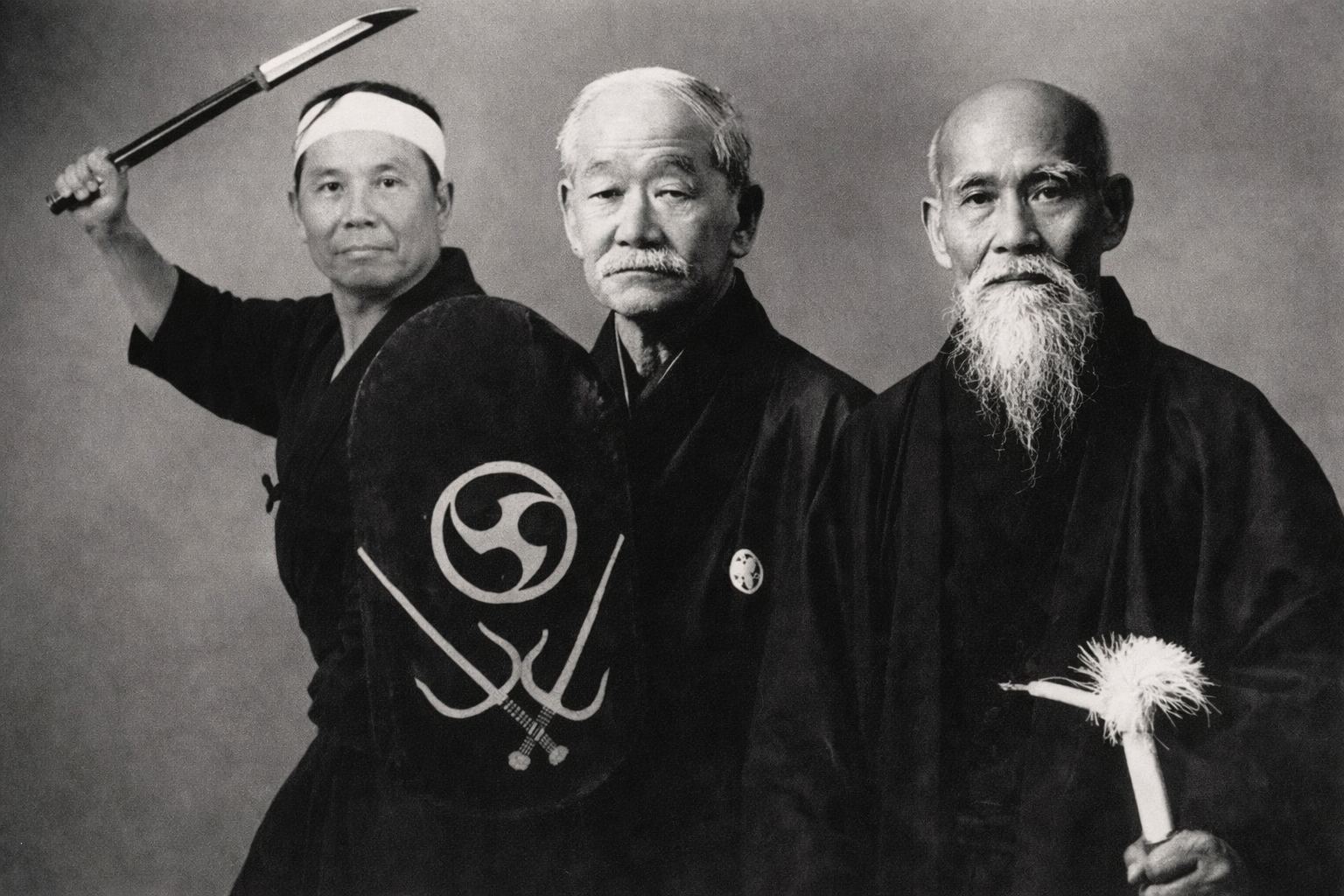
Judo, founded by Jigoro Kano, (Middle of Picture at top of page) refined grappling into a disciplined, educational system.
Aikido, developed by Morihei Ueshiba, (right of picture at top of page) transformed combat into a flowing, defensive art.
Kobudo, the weapons tradition of Okinawa, developed by Taira Shinken (left of picture at top of page) preserved tools of self-defense alongside empty-hand techniques.
Karate, sitting at the crossroads, absorbed ideas from all three—sometimes openly, sometimes quietly hidden within its forms.
Judo: The Hidden Grappling Within Karate
Although Karate is widely known for striking, many of its traditional movements conceal techniques that look remarkably like Judo.
Historically, this connection was strengthened when Jigoro Kano supported Gichin Funakoshi, helping introduce Karate to Japan in the 1920s. Funakoshi even adopted Judo’s uniform (gi) and ranking system, making Karate more accessible to Japanese society.
But the deeper link lies in technique.
Many Karate kata (forms) include movements that, when properly interpreted (a practice called bunkai), reveal:
Throws similar to O-Goshi or Seoi-Nage, Sweeps like O-Soto-Gari Joint locks and close-range controls. Karate also shares key principles with Judo:
Kuzushi (breaking balance), Ashi sabaki (footwork and positioning)
These ideas are essential for both throwing an opponent and delivering effective strikes. Even ukemi (breakfalls)—a staple of Judo—becomes important for advanced Karate practitioners exploring these deeper applications.
In essence, Judo represents the grappling heart hidden inside Karate’s striking body.
Aikido: The Flow Behind the Force
Where Judo emphasizes structure and leverage, Aikido brings softness and flow.
Karate techniques are often direct—linear punches, sharp kicks, decisive blocks. Aikido, by contrast, teaches practitioners to Blend with an attack rather than meet it head-on, Use circular motion to redirect force, Control opponents through joint locks and balance disruption.
These ideas are not foreign to Karate—they are simply less obvious. Within the bunkai of many kata, you can find Subtle body shifts (tai sabaki), Circular deflections, Joint manipulations similar to Aikido techniques.
Training in Aikido often helps Karate practitioners become more adaptable, especially in close-range situations where brute force is less effective.
Philosophically, both arts also align. They emphasize: Discipline, Self-control,Defensive awareness rather than aggression. If Judo reveals Karate’s hidden structure, Aikido reveals its hidden fluidity.
Kobudo: The Original Sister Art
To truly understand Karate, you have to step back into Okinawa—where Karate and Kobudo were once practiced side by side. Kobudo focuses on traditional weapons such as: Bo (staff), Sai and Nunchaku to name a few. These were often everyday tools adapted for self-defense. Over time, as Karate was modernized and introduced to Japan, weapons training was separated, creating two distinct paths. But their connection never disappeared. In fact, Kobudo helps explain Karate at a fundamental level: The same body mechanics are used in both, Weapons are treated as an extension of the body, Many kata movements directly translate between empty hand and weapon forms There’s a saying in Okinawan martial arts: “Good Karate naturally becomes good Kobudo.”
Some kata even exist in parallel forms—performed with and without weapons—showing just how closely the systems are linked.
Kobudo preserves the original context of Karate, reminding us that it was once a complete system of armed and unarmed self-defense
One Art, Many Layers
When you bring these three influences together, Karate begins to look very different. From Judo, it gains balance, throws, and grappling awareness. From Aikido, it gains flow, redirection, and subtle control and from Kobudo, it retains its historical roots and weapon-based logic. What seems like a simple block in Karate might actually be:
A Strike, a joint lock (Aikido), A setup for a throw (Judo) Or a weapon movement without the weapon (Kobudo).
This is why traditional Karate is often described as containing “hidden techniques.” They are not obvious - they must be studied, interpreted, and felt through practice.
Karate as a Living System
Today, many practitioners return to these connections, blending arts to create a more complete understanding: Striking at distance (Karate), Grappling up close (Judo), Flowing and adapting under pressure (Aikido) and understanding movement through weapons (Kobudo).
Some styles, like Wado-Ryu, already embody this synthesis, combining Karate with traditional Jujutsu principles. Rather than separate systems, these arts can be seen as different expressions of the same idea: efficient, controlled, and thoughtful self-defense.
Final Thought
Karate is often introduced as “empty hand,” but that description only scratches the surface. Hidden within its movements are throws, locks, flows, and even weapons—echoes of the arts that shaped it. To study Karate deeply is not just to learn how to strike. It is to uncover the layers beneath, Which is why Stafford Shotokan Karate also incorporate Nage Waza, (throws) Dori Gatame, (Grabbing techniques) Jime Waza, (Chokes) Iai, (Kneeling Sparring) Ne Waza (Ground work) Kobudo (weapons) and Kyusho Waza (pressure points / vital point techniques).
So next time when somebody says to you there are no throws in karate, it’s all punching and kicking, tell them to have a really hard look deeper into their own training as Judo, Aikido, and Kobudo quietly live within every movement of karate.